1️⃣ What are lacing cords used for?
Lacing cords are high-strength textile cords used to tie, bundle, and secure wire harnesses or cable assemblies.
They’re widely used in aerospace, defence, and electronics applications where reliability, temperature resistance, and durability are critical.
Unlike plastic cable ties, lacing cords offer a smooth, low-profile finish and remain flexible under extreme conditions.
2️⃣ What’s the difference between lacing cords and lacing tapes?
Lacing cords are round, braided cords (also known as lacing twines) designed for tying and knotting.
Lacing tapes are flat, woven materials used for wrapping or bundling larger cable groups.
Both serve the same function — securing wire harnesses — but cords are preferred where space is tight or precise tying is required.
3️⃣ What materials are Breyden lacing cords made from?
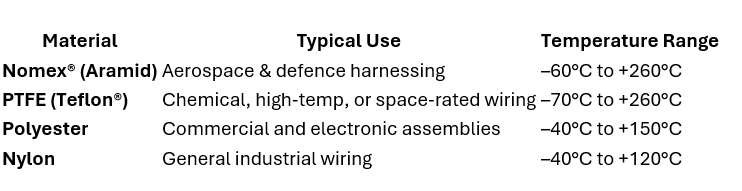
Breyden manufactures Nomex®, PTFE (Teflon®), polyester, and nylon lacing cords, each chosen for its unique performance characteristics:
4️⃣ Are these cords compliant with aerospace and military specifications?
✅ Yes — Breyden’s Nomex and PTFE lacing cords are fully compliant with MIL-T-43435, NASA-STD-8739.4, and other applicable ASD-EN standards.
They’re produced under a certified ISO 9001:2015 and AS9100D quality system to ensure traceability, consistency, and reliability.
5️⃣ What’s the difference between waxed and unwaxed cords?
Waxed cords have a light wax coating that improves grip, knot security, and handling efficiency during manual lacing.
Unwaxed cords are typically used in automated processes or when the specification requires a “dry” finish. Breyden offers both versions across its Nomex and PTFE ranges.
6️⃣ What sizes and packaging options are available?
Breyden lacing cords are supplied on tubes or spools ranging from 25 to 500 yards, depending on material type and specification.
Common diameters range from 0.030” to 0.125”. Standard colours include natural, white, and black, with other options available for special orders.
7️⃣ Why use lacing cords instead of cable ties?
Cable ties are convenient, but lacing cords offer key advantages:
– No sharp edges or bulky heads
– Superior heat and chemical resistance
– No outgassing, making them space- and avionics-safe
– Uniform tension and cleaner harness appearance
– Compliance with military and aerospace standards*
They’re the preferred choice in environments where safety, compliance, and longevity matter most.
8️⃣ How do I choose the right type of lacing cord?
Start with your operating environment and specification:
– Choose Nomex® Type I for most aerospace harnesses.
– Choose PTFE Type II for high-temperature or chemical exposure.
– Use polyester for commercial or electronics assembly.
– Always confirm MIL-T-43435 Type and required temperature rating before ordering.
9️⃣ Can I request certifications or test data?
Yes — material certifications, Certificates of Conformance (C of C), and lot traceability documents are available upon request.
All cords are manufactured under Breyden’s ISO 9001 / AS9100 certified quality system with full batch control.
🔟 How should lacing cords be stored?
Store spools in a cool, dry environment away from direct sunlight and chemical vapours. Maintain original packaging for traceability labels and lot information.
When stored correctly, lacing cords have an extended shelf life and retain their mechanical and thermal properties.
11️⃣ Where can I buy aerospace-grade lacing cords?
You can order aerospace-grade Nomex and PTFE lacing cords directly from LacingCords.com, sourced from Breyden Products, Inc.
For related materials like lacing tapes, heat shrink tubing, or EMI shielding products, visit our partner site SpeedTapes.com.